
Within seconds, temperatures across its 16.5-foot-wide heat shield will climb to some 5,000 degrees — half as hot as the visible surface of the sun — as the ship rapidly slows in an electrically charged fireball of atmospheric friction.
The four astronauts on board — commander Reid Wiseman, Victor Glover, Christina Koch and Canadian astronaut Jeremy Hansen — are counting on the heat shield to keep them safe, in a comfortable environment, all the way through the peak heating zone to a parachute-assisted splashdown in the Pacific off the coast of California.
“We have high confidence in the system, in the heat shield and the parachutes and the recovery systems we put together,” Amit Kshatriya, NASA’s associate administrator, said Thursday. “The engineering supports it, the Artemis I flight data supports it. All of our ground tests support it, our analysis supports it, and tomorrow the crew is going to put their lives behind that confidence.”
NASA
The crew and mission managers are confident, they say, despite major problems with the heat shield that was used during the unpiloted Artemis I test flight in 2022, when the Avcoat material making up the shield developed sub-surface cracks and gas pockets that blew away chunks of the protective barrier’s outer “char” layer.
Based on nearly two years of tests and analysis, engineers were surprised to discover the damage was most likely caused by the Avcoat material’s lack of permeability during a specific phase of the reentry when the shield was experiencing lower external temperatures while internal layers were still extremely high, generating gas that could not escape.
Agency managers decided to order a different heat shield design for downstream Artemis missions. But the heat shield for the Artemis II flight, identical to the one used with Artemis I, was already installed. Replacing it with a new design would have delayed the mission by 18 months or more.
NASA 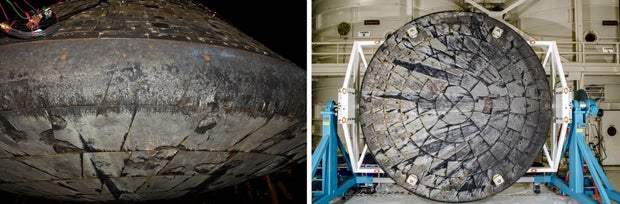
Instead, NASA managers opted to launch Artemis II “as is” based on test data and an exhaustive analysis that indicated the shield would work properly if the reentry trajectory was modified to eliminate the temperature and pressure swings that contributed to the damage seen after the Artemis I flight.
“They did a tremendous amount of research, a lot of groundbreaking research in some facilities that we had not used before, and they discovered the root cause,” Wiseman said.
“They did wind tunnel testing and laser testing and hyper-velocity testing, and they determined that if we come in with this lofted profile … that this heat shield will be safe for us to go fly.
“So I think all that points in the direction of goodness,” he said. “And I think if you, as a human being who was about to board this rocket, had sat in the meetings that we sat in and listened to the experts and gone through the data with them, you would have the same comfort.”
What went wrong with Artemis I?
During the Artemis I mission, the unpiloted capsule followed a planned “skip” trajectory, similar in concept to skipping a flat stone across still water. After an initial dip into the upper atmosphere, the Artemis I capsule skipped back out again before making its final descent to splashdown. The skip reentry helps reduce the spacecraft’s velocity while offering NASA a wider range of splashdown options in case bad weather makes a targeted landing site problematic.
NASA 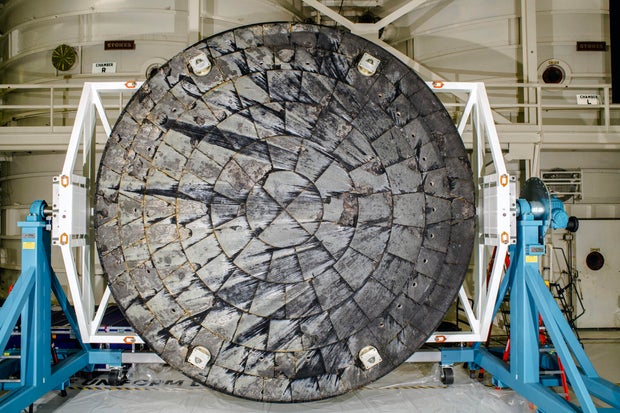
Despite the heat shield damage seen after the flight, the Artemis I reentry was successful. The capsule landed on target, and officials said that had any astronauts been aboard, they would have had no problems. But the damage triggered alarm at NASA.
“NASA identified more than 100 locations where ablative thermal protective material from Orion’s heat shield wore away differently than expected during reentry into Earth’s atmosphere,” NASA’s Office of Inspector General wrote.
“While the heat shield successfully protected the Crew Module and its systems during the Artemis I mission, upon inspection after Orion’s recovery, engineers noted unexpected variations in the appearance of the heat shield Avcoat — the ablative material that helps protect the capsule from the heat of reentry.
“Specifically, portions of the char layer wore away differently than NASA engineers predicted, cracking and breaking off the spacecraft in fragments that created a trail of debris rather than melting away as designed,” the office said. “The unexpected behavior of the Avcoat creates a risk that the heat shield may not sufficiently protect the capsule’s systems and crew from the extreme heat of reentry on future missions.”
NASA 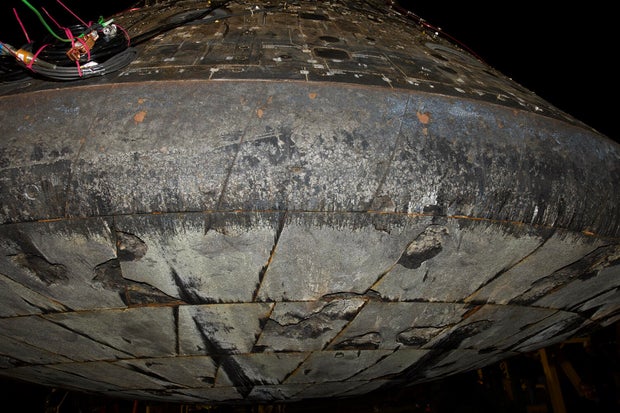
Testing revealed the damage was related to the heat shield’s permeability, or rather, its lack thereof. After the initial, relatively deep dive into the atmosphere, the Avcoat material making up the shield was unable to properly dissipate the heat that remained in its lower layers during the skip back out of the atmosphere.
Entry heating is what makes the Avcoat’s outer char layer permeable enough to allow gas to escape. The Artemis I heat shield worked normally during its initial descent into the atmosphere. But when it climbed back out, reentry heating eased and the outer char layer became much less permeable.
The underlying material was still extremely hot, undergoing a process known as pyrolysis — combustion without oxygen — and generating gas that had no way to escape. Those buildups eventually blew chunks of the heat shield’s outer layers away.
“They go back up from that first entry, they’re still hot, they’re still off-gassing,” said an engineer familiar with the investigation. “The fact that the material itself isn’t permeable enough is causing that gas pressure to build up now, very rapidly, because they’re still hot. But the char layer has paused.”
NASA 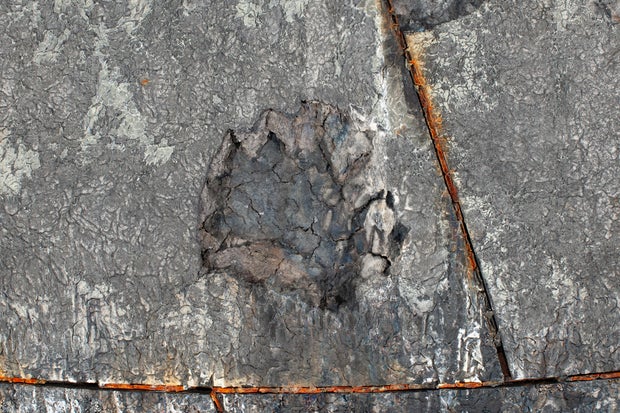
The outer char layer is “the only part of the Artemis I and Artemis II heat shield that actually allows it to breathe, or allows it to off-gas. So once it stops, now there’s no mechanism in the deeper parts of the heat shield for that gas to escape,” he said.
“So the pressure built up, and as the capsule came back down and started reheating, the pressure was already there.
“All those cracks, the pockets had already formed. And now, bang, bang, bang, pop. Avcoat started sloughing off during that second entry,” the engineer said.
A modified reentry trajectory should solve the problem
Engineers verified in lab tests that a modified skip-entry trajectory — one with an initial dip into the upper atmosphere followed by a shorter-duration climb back out — would allow the Avcoat to “breathe” throughout, preventing the formation of cracks and trapped gas. An independent review team agreed with those conclusions.
NASA 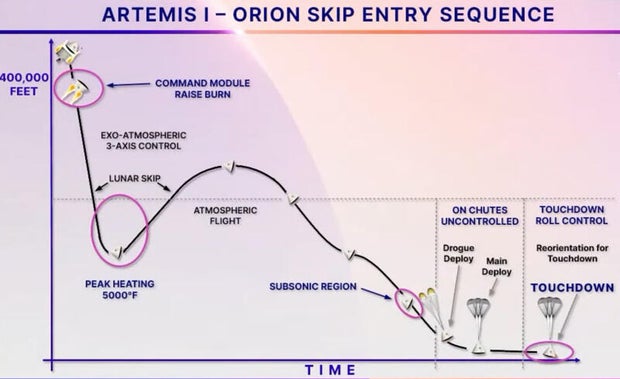
Interestingly, Apollo engineers were aware of the Avcoat permeability issue and designed that program’s heat shields accordingly. Apollo capsules also used skip reentry trajectories and had no problems. But the Avcoat used in the Artemis heat shields was reformulated slightly, and that ended up affecting its permeability.
In any case, the downside to the modified reentry trajectory for Artemis II will reduce the distance the Orion capsule can fly to avoid bad weather in the planned splashdown zone. It will also result in higher sustained heating during the descent, but engineers say that is exactly what is needed to maintain permeability in the outer char layer and ensure good performance.
Former astronaut Charles Camarda disagreed, strongly criticizing the “fly as is” decision. He argues that engineers do not fully understand the root cause of the Artemis I heat shield damage and cannot accurately predict how the Artemis II heat shield will perform or whether the revised entry trajectory might have unintended consequences.
In a letter to the NASA administrator, Camarda wrote that “history shows accidents occur when organizations convince themselves they understand problems they do not.”
Like Wiseman, Glover says he trusts the analysis of the Artemis I problem, saying critics “haven’t been in these meetings from day one and met the team and looked them in the eye and shook their hands at the ends of these meetings.”
That said, he added, “I don’t want to discount the things that they’ve said. Any time you talk about fire, any time you talk about entry and heat shields, talk about parachutes, these are high-risk things that … don’t have fault tolerance built in. They have to work.”
“And so I appreciate all of that nudging and poking and prodding that they’ve caused,” Glover said. “They have made us sharpen our pencils and put more due diligence, more vigilance into that process. But I think we’ve done that. And so I think the crew is comfortable because of that team.”
About the Author

Discover more from FRESH BLOG NEWS
Subscribe to get the latest posts sent to your email.


