
“The scary scenarios are, unfortunately, extremely plausible. It’s not at all hard to tell a $150 [per barrel] story, and it’s not crazy to go to $200,” Nobel Prize-winning economist Paul Krugman told CBS News.
U.S. gasoline prices, which are tied to the global price of oil, would likely keep climbing above $4 if the strait remains closed, according to Bernard Yaros, lead U.S. economist at Oxford Economics. The average cost of gas rose on Wednesday to $4.06 a gallon, its highest level since August 2022.
President Trump is scheduled to address Americans on the Iran war on Wednesday night. Energy experts said oil and gas prices will likely move in response to his remarks.
“If the president just foregoes providing clarity or resolution on the Strait of Hormuz, we’re going to continue to see oil prices reacting to the reality,” said Patrick De Haan, a petroleum expert at GasBuddy.
In the near term, the average U.S. price of gas could also edge up to between $4.12 and $4.15 per gallon, he predicted.
But “if the president says good things tonight, then that $4.12 to to $4.15 would likely represent a short-term price peak. And then the national average could start falling,” De Haan said.
Mr. Trump said earlier Wednesday that Iran wants a ceasefire, but he’s made it clear he could end U.S. operations in the region without reopening the strait, leaving other countries to deal with Tehran’s control of the critical shipping lane.
Slowdown in the strait
Since the beginning of the Iran war in late February, more than 70% of all ships transiting the Strait of Hormuz have either been owned by or linked to Iran, or sailing between Iranian ports, according to Lloyd’s List Intelligence, a maritime insights provider.
Normally, 20 million barrels of oil flow through the strait daily. That volume has been reduced by as many as 16 million barrels since the war began.
Bedirhan Demirel/Anadolu via Getty Images 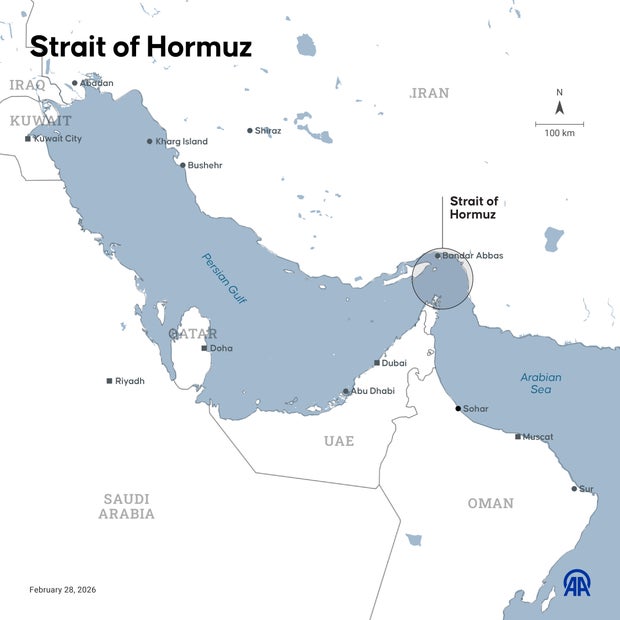
Because there are no direct substitutes for oil and demand for crude is “inelastic,” as economists say, a prolonged closure of the narrow waterway would drive oil prices well beyond their recent highs of around $120 a barrel, Krugman said.
The economist also points to two key factors that he said would influence the price of crude if the strait remains shut: the volume of oil that could traverse the Persian Gulf, and how purchasers of crude would respond to potentially much higher oil prices.
Risks for consumers
Bridget Payne, head of oil and gas forecasting at investment advisory firm Oxford Economics, expects oil prices to rise above $150 a barrel within weeks if the strait remains too dangerous to navigate. That would mean higher energy prices for consumers.
“At the speed we’re seeing prices grow, the pass-through impact on consumer prices becomes a lot worse the longer oil supply stays offline,” Payne told CBS News.
Although moves by the Trump administration to boost oil supplies during war have shielded the U.S. from even sharper hikes in fuel prices, such efforts will become less effective over time, she added. “It’s no match for the scale that goes through the strait. It doesn’t come anywhere near touching how much has been lost.”
Roughly a fifth of the world’s oil and natural gas supply passes through the Strait of Hormuz daily.
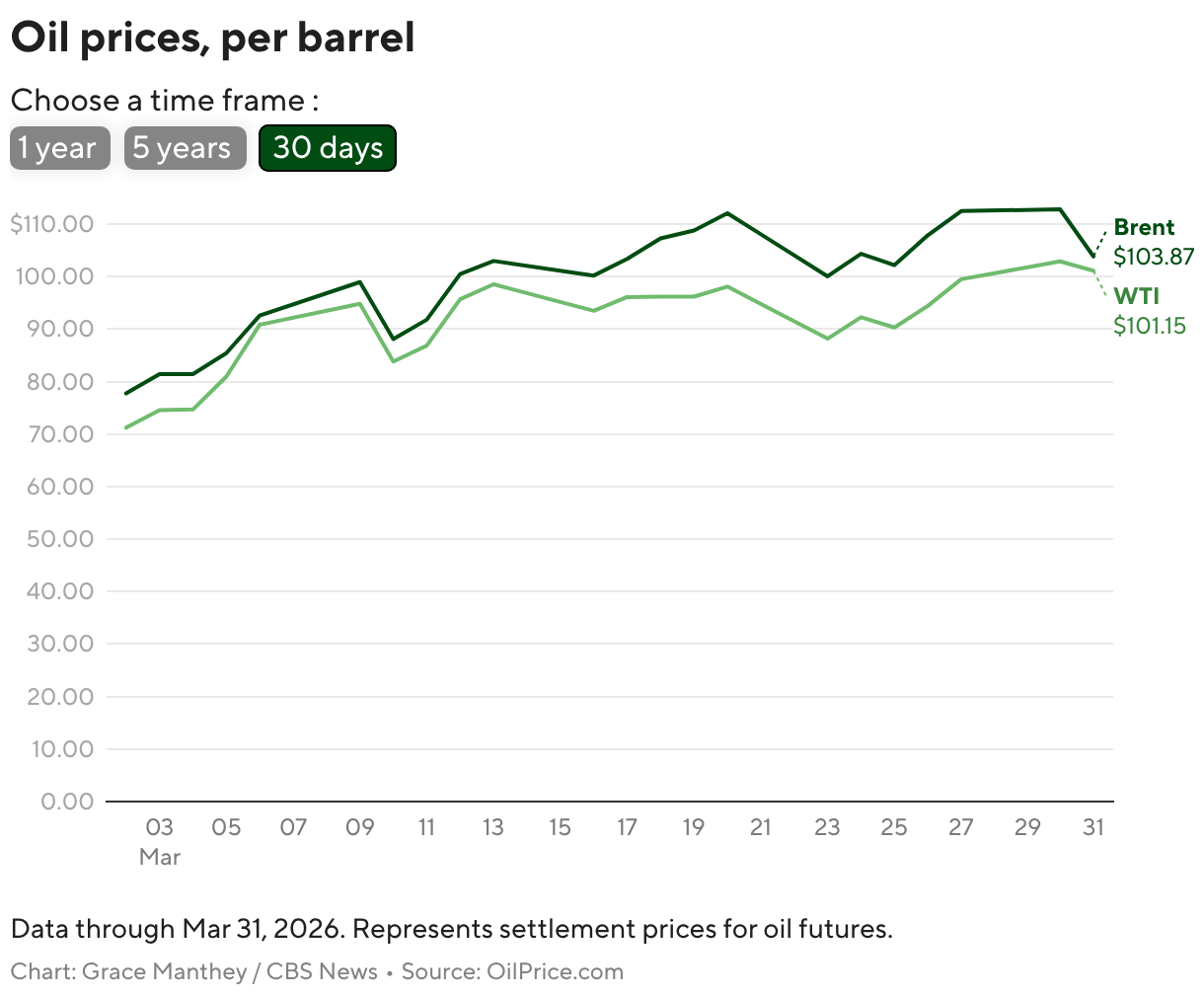
Matt Bernstein, oil and gas analyst at Rystad Energy, thinks oil prices are likely to remain elevated even if the U.S. moves quickly to start pulling its forces out of the region.
“Even if the conflict did wind down in the next couple of weeks and that strait gradually reopened, what’s starting to become clear is there is no going back to pre-war normal,” Bernstein told CBS News, pointing to the higher geopolitical and financial risks around trade in the Gulf.
If the Strait of Hormuz “remains de facto closed and [oil] supply is still constrained, we’d be in a situation where there is no downward pressure on oil prices,” he added.
About the Author

Discover more from FRESH BLOG NEWS
Subscribe to get the latest posts sent to your email.


