
The White House on Wednesday said that Iran backed down to President Donald Trump in agreeing to a ceasefire deal, arguing his “red lines” haven’t changed as the focus shifts to upcoming negotiations between the U.S. and Tehran.
The two-week halt in fighting was announced by Trump just 90 minutes before his self-imposed Tuesday evening deadline for Iran to make a deal to reopen the Strait of Hormuz or, in his apocalyptic warning, a “whole civilization will die.”
“The world should take his word very seriously,” Leavitt told reporters at Wednesday’s White House briefing, defending his language when faced with reporter questions about whether it was appropriate when talking about civilian targets such as bridges and power plants.
“And understanding that the president is always most interested in results. And it was the Iranians who backed down, not President Trump,” Leavitt continued.
She said his “tough rhetoric” and negotiating style “led the Iranian regime to cave to their knees and ask for a ceasefire.”
Evelyn Hockstein/Reuters
But there are many unanswered questions about what comes next and the proposals behind the ceasefire.
Trump’s six-week war saw hostilities spread throughout the region and an oil crisis gripped the global economy. The conflict also caused some fractures within the Republican Party and the president’s MAGA base.
Now, the White House and top officials declaring the military campaign and ceasefire a “victory.” Defense Secretary Pete Hegseth, in a Pentagon briefing, spoke of the conflict in the past tense, though he said U.S. forces would remain in the region to ensure Iran complies with the truce.
Trump on Tuesday night called an Iranian 10-point counterproposal a “workable basis” for negotiations for a long-term peace.
Iranian state media on Tuesday reported a statement from the Supreme National Security Council that said the U.S. accepted a plan that included the acceptance of uranium enrichment and lifting of all sanctions — terms the U.S. and the president himself have long rejected.
“That is false,” Leavitt said of the Iranian state media’s report on Wednesday.
“The Iranians originally put forward a 10-point plan that was fundamentally unserious, unacceptable and completely discarded. It was literally thrown in the garbage by President Trump and his negotiating team,” she said.
With Trump’s deadline fast approaching, Leavitt said the Iranian regime “acknowledged reality” and “put forward a more reasonable and entirely different and condensed plan to the president and his team.”
That “new” and “modified” plan, according to the White House, was more aligned with the U.S. framework, although it has not made it public.
Iranian’s foreign minister on Tuesday said the U.S. accepted the “general framework on Iran’s 10-point plan” but did not detail what it contained.
“The idea that President Trump would ever accept an Iranian wish list as a deal is completely absurd,” Leavitt said. “The president will only make a deal that serves in the best interests of the United States of America.”
She added, “What Iran says publicly or feeds to all of you in the press is much different than what they communicate to the United States, the president and his team privately.”
The upcoming talks — scheduled for Saturday morning local time in Islamabad, Pakistan — will be led by Vice President JD Vance, White House special envoy Steve Witkoff and Jared Kushner, the White House said on Wednesday.
Despite claims of victory, Leavitt urged “patience” in talks and both she and Vance have acknowledged the uncertainties of a ceasefire.
“This is a fragile truce. Ceasefires are fragile by nature,” she said.
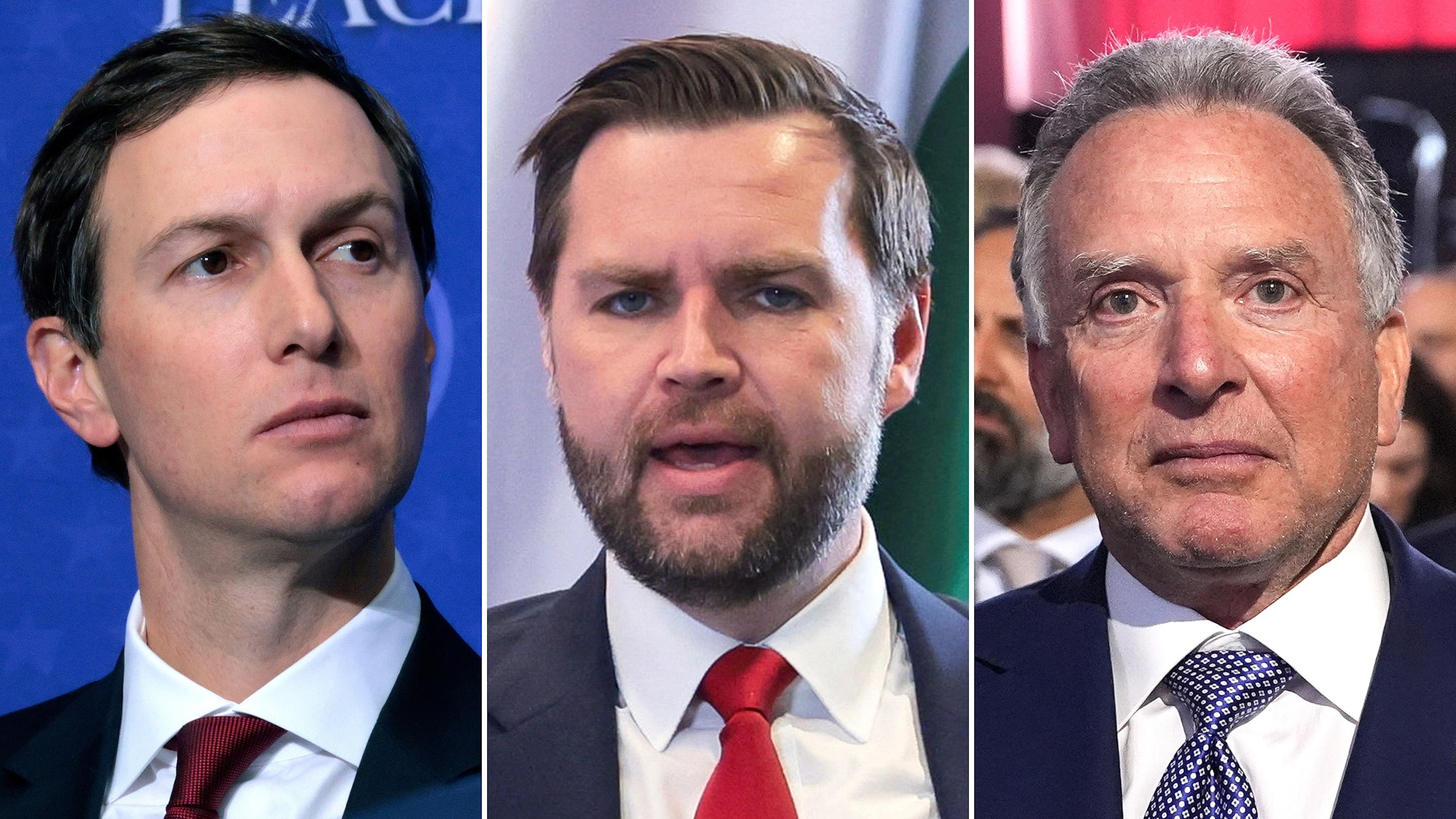
Getty Images/Reuters/AP
On the top of the priority list in the talks, Leavitt said, is the issue of Iran’s highly enriched uranium.
“That is a red line that the president is not going to back away from,” Leavitt said. “And he’s committed to ensuring that takes place. We hope it will be through diplomacy.”
Not allowing Iran to have a nuclear weapon was a central justification for the war.
Iran had previously committed not to build a nuclear weapon as part of negotiations with the West, yet continued to enrich nuclear material to levels nearing weapons grade. Though the U.S. intelligence community’s assessment was that Iran was not pursuing a nuclear weapon in the wake of last summer’s Operation Midnight Hammer, which Trump said “obliterated” the country’s nuclear weapons program.
On Wednesday morning, Trump notably said the U.S. will “work closely with Iran” to remove the nuclear material.
“There will be no enrichment of Uranium, and the United States will, working with Iran, dig up and remove all of the deeply buried (B-2 Bombers) Nuclear ‘Dust.’ It is now, and has been, under very exacting Satellite Surveillance (Space Force!). Nothing has been touched from the date of attack,” Trump wrote in a social media post.

Mark Schiefelbein/AP
Hegseth, during Wednesday’s Pentagon briefing, said Iran will “either give it to us voluntarily” or “if we have to do something else ourselves … we reserve that opportunity.”
“That’s something the president is going to solve for,” Hegseth said.
A mission to seize the nuclear material would require a large special operations force on the ground, experts previously told ABC News.
Another major question mark going forward is the Strait of Hormuz, where roughly one-fifth of the world’s oil has been caught in the crosshairs of the war. Iran effectively shut down the waterway in retaliation.
The ceasefire in place now, Trump posted Tuesday evening, was tied to Iran’s “COMPLETE, IMMEDIATE and SAFE OPENING” of the strait.
Early Wednesday, President Trump — in a phone call with ABC News Chief Washington Correspondent Jonathan Karl — floated the idea of a “joint venture” between the U.S. and Iran of charging a toll for ships to pass through.
“We’re thinking of doing it as a joint venture. It’s a way of securing it — also securing it from lots of other people,” Trump told ABC’s Karl.
Leavitt said it was “an idea” from Trump that would be discussed over the coming weeks, but that “the immediate priority of the president is the reopening of the strait without any limitations, whether in the form of tolls or otherwise.”
Leavitt was asked who currently controlled the Strait of Hormuz and declined to answer.
“We expect that the strait will be opened immediately,” she said. “As I’ve said earlier, we have seen an uptick in traffic in the strait, and it’s something that we are monitoring minute by minute, hour by hour, as the days go on.”
About the Author

Discover more from FRESH BLOG NEWS
Subscribe to get the latest posts sent to your email.

