
The two-stage Vulcan rocket thundered to life at 4:22 a.m. EST and majestically climbed away from pad 41 at the Cape Canaveral Space Force Station atop 2.9 million pounds of thrust from twin methane-burning Blue Origin BE-4 engines and four Northrop Grumman solid-fuel boosters.
United Launch Alliance
The initial moments of the flight appeared to go smoothly, but about 20 seconds after liftoff, one of the strap-on GEM 63XL boosters suffered what appeared to be a burn-through in its nozzle, with a jet of flame suddenly appearing and shooting out to one side.
“We had an observation early during flight on one of the four solid rocket motors,” ULA said in a post on X. “The team is currently reviewing the data.” The company said the Vulcan core stage, upper stage and spacecraft continued to perform “nominally.”
Later in the ascent, shortly before the boosters were jettisoned, tracking cameras showed the rocket began a fairly rapid roll about its long axis.
Whether that unexpected motion was caused by the sideways thrust from the failed nozzle or by some other problem was not known. But once the boosters were jettisoned, the unusual motion slowed and stopped.
Adam Bernstein / Spaceflight Now 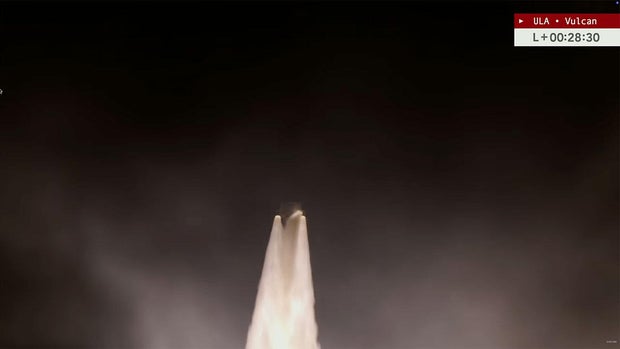
In any case, as usual with classified military missions, ULA ended its launch broadcast shortly after the second stage engine ignition. No further updates were expected until after the planned 10-hour mission concluded.
It was the fourth launch of ULA’s new Vulcan, a heavy-lift rocket with all-American components intended to replace the company’s Atlas 5, powered in part by Russian-built first-stage engines, and its already-retired Delta 4 family of launchers.
Two “certification” flights were launched in 2024 to clear the rocket for use carrying high-value national security payloads. A nozzle failure during the second certification flight triggered a lengthy investigation and corrective action.
The Vulcan’s third flight in 2025 successfully launched the the rocket’s first Space Force payload. Thursday’s launch was the rocket’s second classified mission and its fourth overall.
ULA officials said before launch that the company planned to launch more than 20 flights this year, two to four Atlas 5 missions along with 16 to 18 Vulcan flights, utilizing launch pads on both coasts. Whether work to resolve the apparent nozzle failure might cut into that schedule is not yet known.
USSF 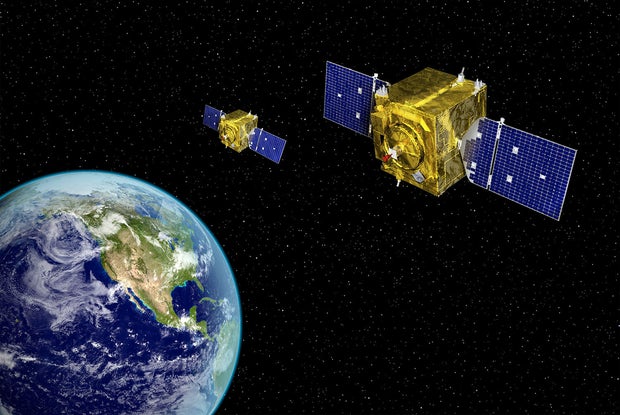
The primary payload Thursday was a Geosynchronous Space Situational Awareness Program (GSSAP) satellite, built by Northrop Grumman and designed to keep tabs on behavior and movement of other satellites in a 22,300-mile high orbit above the equator.
At that altitude, satellites circle the globe in lockstep with Earth’s rotation and thus appear stationary in the sky. Geosynchronous orbit is favored by scores of civilian and military communications satellites, electronic eavesdropping spacecraft and others.
The GSSAP satellites are intended “to improve the country’s ability to rapidly detect, learn, characterize and attribute disturbances to space systems in the geosynchronous environment,” said Gary Wentz, ULA vice president of the company’s Atlas and Vulcan programs.
Going into Thursday’s launch, ULA had put up six GSSAP space surveillance stations, launching them in pairs in 2014, 2016 and 2022 using two Delta 4 rockets and an Atlas 5. During a pre-launch news conference, ULA managers declined to say how many GSSAPs might have been aboard the Vulcan for Thursday’s flight.
Mounted below the GSSAP in the Vulcan’s nose cone was another spacecraft known as an ESPAStar, a solar-powered deployable platform “capable of accommodating any combination of up to six hosted and 12 separable (fly-away) payloads,” according to Northrop Grumman. All of the ESPAStar payloads launched Thursday were classified.
Mission managers said before launch the flight would mark the longest yet for a ULA rocket, a 10-hour trip to multiple points in near-geosynchronous orbit.
“This is the type of mission that the team actually designed this launch vehicle to support,” Wentz said. “It’s significant payloads to very complex orbits, multi-manifested national security space, direct-to-geo. So this is tailor-fit for that mission.”
The United Launch Alliance is a 50-50 Boeing-Lockheed Martin joint venture.
About the Author

Discover more from FRESH BLOG NEWS
Subscribe to get the latest posts sent to your email.


