
AST SpaceMobile of Midland, Texas, builder of the BlueBird 7 satellite, said in a statement the cellular relay station’s on-board propulsion system could not compensate for the lower-than-planned altitude.
Adam Bernstein/Spaceflightnow.com
“During the New Glenn 3 mission, BlueBird 7 was placed into a lower-than-planned orbit by the upper stage of the launch vehicle,” the company said. “While the satellite separated from the launch vehicle and powered on, the altitude is too low to sustain operations with its on-board thruster technology and will de-orbited.”
The cost of the satellite was not revealed, but the company said it was fully insured.
The New Glenn launched Sunday was Blue Origin’s third and the first using a previously flown first stage. The company is owned by Amazon-founder Jeff Bezos.
Liftoff from the Cape Canaveral Space Force Station came at 7:25 a.m. ET, 40 minutes after an unexplained hold in the countdown. When the count finally hit zero, the towering rocket’s seven methane-burning BE-4 engines ignited with a ground shaking roar and the booster began climbing away atop 3.8 million pounds of thrust.
Blue Origin 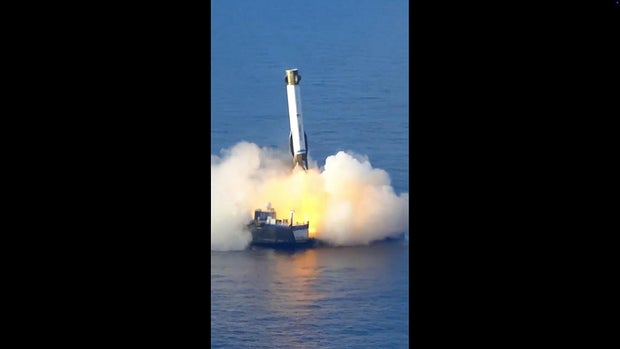
The first stage appeared to work flawlessly, shutting down and falling away as planned about three minutes and nine seconds after liftoff. The rocket’s second stage, powered by two BE-3 engines, then ignited to continue the climb to an initial orbit.
The first stage, meanwhile, headed for a Blue Origin’s landing barge stationed several hundred miles down range in the Atlantic Ocean, flying itself to an on-target touchdown about nine minutes and 20 seconds after launch.
The same stage accomplished the same feat last November during the second flight of a New Glenn — NG-2 — albeit using a different set of engines.
“With our first refurbished booster we elected to replace all seven engines and test out a few upgrades including a thermal protection system on one of the engine nozzles,” Blue Origin CEO Dave Limp said in an earlier social media post. “We plan to use the engines we flew for NG-2 on future flights.”
About two-and-a-half minutes after the first stage landing Sunday, the second stage engines shut down as planned. A second upper stage engine firing was expected an hour and 10 minutes after launch, but that time came and went without any updates from Blue Origin.
About an hour later, however, the company reported the satellite had not been released into its intended orbit. The post did not say whether the second upper stage engine firing actually took place or if it did, whether it ran for the full duration.
“We have confirmed payload separation,” Blue Origin posted on X. “AST SpaceMobile has confirmed the satellite has powered on. The payload was placed into an off-nominal orbit. We are currently assessing and will update when we have more detailed information.”
The BlueBird 7 satellite was equipped with a 2,400-square-foot phased array antenna, the largest civilian antenna of its type ever put in low-Earth orbit.
The satellite is the second in a new generation of AST SpaceMobile data relay stations designed to seamlessly provide space-based 4G and 5G cellular broadband service directly to cell phone users anywhere in the world.
AST SpaceMobile 
The company plans to deploy up to 60 such “block two” BlueBirds in an initial constellation, launching them with SpaceX Falcon 9 rockets, Indian LVM3 boosters and Blue Origin’s New Glenn.
Despite the mishap Sunday, AST SpaceMobile said it “continues to expect an orbital launch every one to two months on average during 2026, supported by agreements with multiple launch providers, and it continues to target approximately 45 satellites in orbit by the end of 2026.”
Blue Origin plans to compete head-to-head with SpaceX to deliver commercial, military and science satellites to Earth orbit and deep space while deploying a fleet of Amazon-owned space-based LEO internet satellites intended to compete with SpaceX’s already-established Starlink system.
Blur Origin also is developing moon landers to deliver NASA cargo and astronauts to the lunar surface.
The New Glenn rocket is critical to all of those ventures. The company tentatively plans to launch a prototype Blue Moon lander on an unpiloted test flight late this summer or early fall, followed by one and possibly two launches of Amazon LEO internet satellites before the end of the year.
But those plans will depend on the results of an investigation into what went wrong Sunday.
About the Author


