“I’ve done this 34 years. I have never worried and stressed like I have the last year,” Bell told CBS News in an interview on Wednesday at his farm in Kings Mountain, North Carolina.
Bell has been forced to make significant changes to his operation as a result of the high costs. He’s shifting some of his acreage, trying to stretch out the lifespan of his equipment and producing his own fertilizer. His children have also opened up a storefront where visitors can pick pumpkins and take hayrides in the fall. But Bell is still feeling the pinch.
“We’ve cut everything we can cut,” he said. “The last several years in agriculture have been terrible, and we have, you know, just cut the fat anywhere we could. But we’re just getting to the point now there’s nothing left to cut. You cannot run without fuel. You cannot run without fertilizer. You have to have that.”
Bell says his diesel fuel costs have about doubled since last year
The war with Iran has driven up fuel costs and created supply chain disruptions as the Strait of Hormuz remains under a naval blockade with a limited number of oil tankers allowed through the critical waterway. And the intensifying conflict between Yemen’s Iran-backed Houthi rebels and Saudi Arabia and attacks by other Iranian proxy forces on Saudi infrastructure are squeezing global fuel supplies in the Red Sea and contributing to a spike in global fuel costs.
Fighting in Russia and Ukraine has also limited oil refining capacity, driving up prices further.
Diesel prices nationwide are averaging roughly $6.40 per gallon, according to AAA, nearly double the average price a year ago. In North Carolina Thursday, diesel prices hit their highest recorded average of $6.19 per gallon.
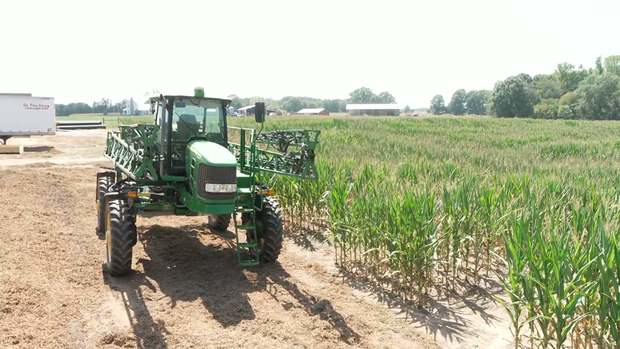
Prices have been so volatile that Bell said the price he’s quoted from his distributor in the morning is only valid until the afternoon — when it rises again. He can’t avoid the expense — his farm equipment runs on diesel. Bell showed CBS News his combine, which he says now requires about $600 worth of diesel fuel per day. That’s more than twice what he paid last year.
Bell said he blew through his yearly fuel budget of $35,000 in August. Now, he expects his total for the year to be closer to $50,000 to $60,000.
“Every piece of equipment on this farm runs on diesel,” he said. Without it, his farm wouldn’t be able to function.
Tariff impact: “Everything that we touch has gone up”
It’s not just diesel prices that are hurting Bell’s business. President Trump’s wide-ranging tariffs have also driven up costs — and left him and other farmers in limbo as the president continues to threaten to impose more tariffs.
“Everything we’re touching, the fertilizer, fuel, chemicals, seed, parts — you know, the whole nine yards, everything that we touch has gone up,” Bell said, noting that many of the price hikes resulted from Mr. Trump’s tariff policies.
Farmers welcomed Mr. Trump’s announcement in May that he had reached a deal for China to buy 25 million metric tons of soybeans from the U.S. annually through 2028. China has purchased significantly more U.S. soybeans in 2026 compared to 2025, but its 10% retaliatory tariff on U.S. soybeans remains in place. China imposed the levy in response to Mr. Trump’s fentanyl-related tariffs on China.
Bell said China’s soybean tariffs have left the market in limbo: That is, China hasn’t increased the prices it’s paying for U.S. soybeans, even though everything farmers touch in producing soybeans “has gone up.”
In a letter to Mr. Trump on Thursday ahead of his meeting with Chinese President Xi Jinping next week, the American Soybean Association called on him to push for the elimination of the 10% tariff.
“I think we’ve been misled”
Bell initially supported Mr. Trump’s policies and even thought short-term price increases resulting from the Iran conflict would be worth ensuring Iran never has a nuclear weapon, one of the president’s stated goals of the war.
But he now says the administration has made miscalculations in the war. “We’re just being strung along as a country and that’s not good,” Bell said.
Bell criticized the administration’s decision-making around the war, saying, “I think we’ve been misled.”
He also says the administration’s agriculture policy is not what he was promised.
“We were sold a bill of goods that agriculture was going to be on the forefront … and there was going to be some policy that would put America’s farmers and ranchers first. And right now, that has not happened.”
Bell said that while the administration’s farmer bailout program sounds significant, “it’s not a lot of money.”
This November, Bell says he’ll be voting for candidates who he says have “common sense,” and listen to Americans’ concerns.
“I’m a Republican, but I’m probably going to vote a split ticket,” he said.
“We are fighting for survival”
Bell said he knows farmers who have been forced out of business as a result of high costs, unable to sustain their business with rising prices.
“I do not want any Americans to feel sorry for the American farmer,” Bell said. “I want the Americans to be mad that we have been put in this situation. We are fighting for survival, and we’re running out of options.”
And he acknowledged it’s possible he could also be forced to shutter his farm.
“Money’s not the problem, I could care less about the money,” he said. “But we take a lot of pride in what we do. You can’t put a dollar sign on that. But I can’t stay in business under these conditions. Something has got to give.”
But asked what he would do if he wasn’t a farmer, Bell hesitated: “I don’t know. It’s all I’ve ever done.”
About the Author
