July is the first month in President Trump’s second term when people with only civil immigration violations — rather than pending criminal charges or convictions — made up more than half of those arrested. An average of more than 1,580 people were arrested each day in July, also a new high for the current administration.
Enforcement ramped up this summer after a drop following public backlash to the Department of Homeland Security’s operation in Minneapolis, a funding standoff and a shake-up in DHS leadership. But, as has been the case with ICE’s previous big city crackdowns, rising arrest totals come with spikes in community arrests of people without criminal records.
Administration officials have repeatedly claimed that their enforcement efforts are focused on “the worst of the worst” and often tout arrests of immigrants with violent criminal convictions. Those with convictions for violent crimes as defined by the Justice Department’s Bureau of Justice Statistics make up about 6% of all those booked into ICE detention under the current administration, and about 4% of those taken into custody in July, the data show.
“ICE enforces the law as written. What makes someone a target for immigration enforcement is whether or not they are illegally in the U.S.— full stop,” a DHS spokesperson said in a statement to CBS News. “Many of the individuals that are counted as ‘non-criminals’ are actually terrorists, human rights abusers, gangsters and more; they just don’t have a rap sheet in the U.S.”
The data, obtained from ICE by the Deportation Data Project run by the University of California, Berkeley and UCLA, does not provide information about immigrants’ alleged crimes in other countries. CBS News asked DHS to provide that data.
White House border czar Tom Homan has said that sanctuary policies that prevent local law enforcement from turning over people held in jails and prisons to ICE force them to “flood the zone” and deploy more resources to such cities to find and arrest their targets and anyone else they encounter living in the U.S. illegally. Homeland Security Secretary Markwayne Mullin has made similar claims.
“I’m just saying, let’s work to get the worst of the worst off the streets and then you won’t see me in your cities and states like you do as much,” Mullin said at a conference of state governors earlier this month, urging them to increase local law enforcement cooperation with ICE. “You probably won’t even see us at all.”
But June and July data suggests that ICE agents making arrests in communities are not focusing their efforts solely on areas the administration deems to be sanctuary jurisdictions. Those cities and states saw a 27% increase in street arrests during those months compared to the previous six, compared with a 50% increase everywhere else, CBS News’ analysis of the data found.
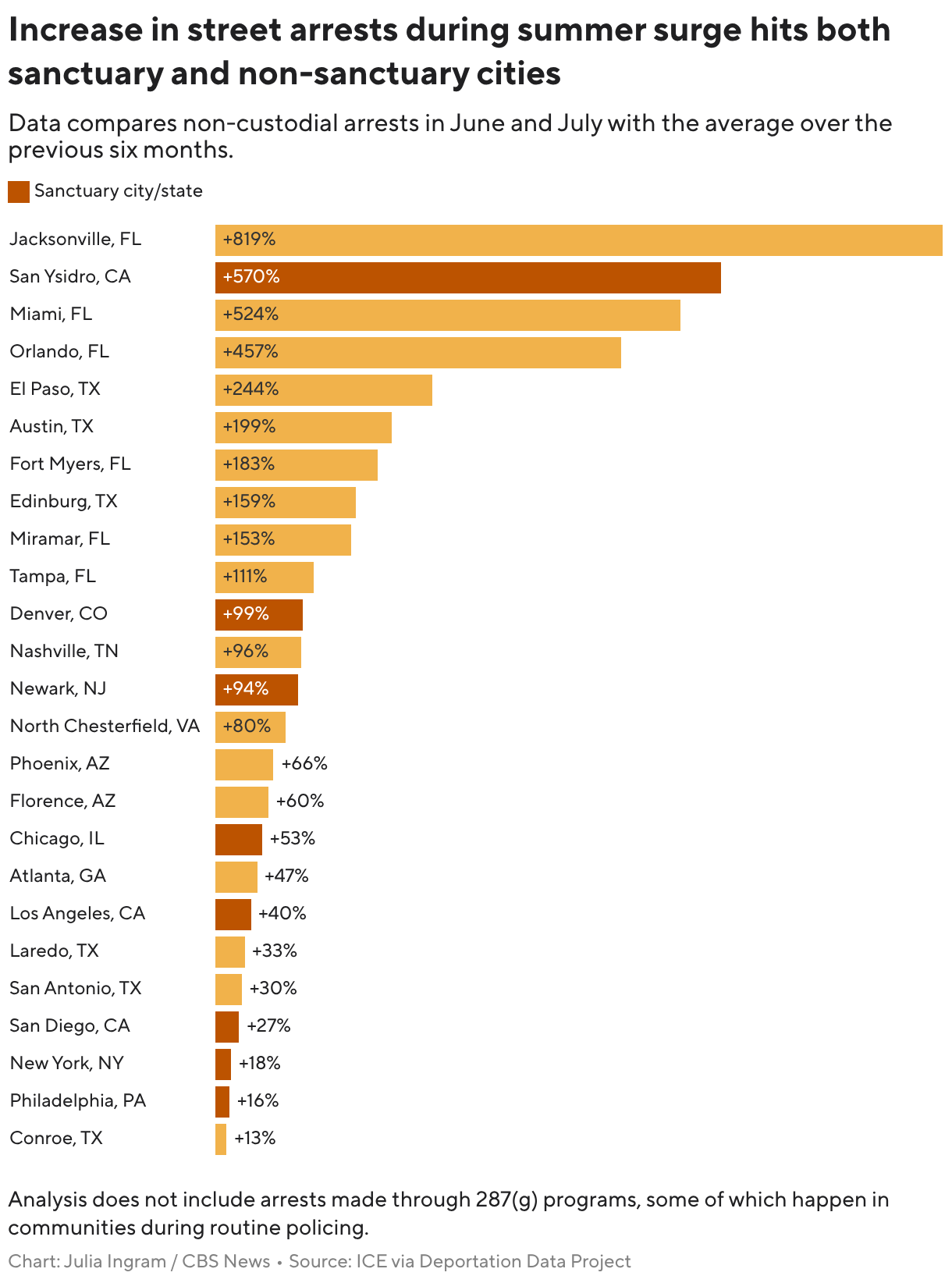
In Florida, where state law requires local law enforcement to collaborate with ICE, federal agents made almost four times as many street arrests in June and July compared to the average over the previous six months. The increase was the highest in Jacksonville, where average monthly arrest totals rose from 18 to 166 this summer. Miami saw an average of 715 per month in June and July, up from 115.
In Texas, another state without sanctuary policies, arrests in communities tripled in El Paso and Austin.
While the overall increase of street arrests in cities with sanctuary policies was lower, some of them saw comparable surges. These arrests in San Ysidro, California, near the U.S.-Mexico border, were more than six times higher in June and July than in previous months, and they doubled in Denver, Colorado, and Newark, New Jersey.
The uptick in arrests has been without highly publicized city-focused crackdowns, with agents instead turning to traffic stops, airport arrests and arrests at immigration check-ins. The killing of two immigrants by federal agents in Maine and Texas during attempted traffic stops reignited outcry.
At least 45,300 ICE arrests in June and July, nearly half of all arrests for those two months, were made in communities rather than in jails or prisons. About 12,700 more came from what are known as 287(g) agreements, in which local law enforcement officials are empowered to make immigration-related arrests. Some street or custodial arrests may have also come through 287(g) programs without being labeled as such.
ICE has 287(g) agreements with more than 1,850 city, county and state agencies. That number has grown each month as DHS seeks to expand the program, allotting $1.15 billion toward it through September 2027.
About the Author
