“You’re definitely scared,” one military spouse said. “As the week goes on, you wake up to ballistic missiles being fired. We went to sleep with the sound of ballistic missiles again.”
Iranian missiles and drones targeted Bahrain consistently for several days after the war began, according to another spouse. The scale and duration of those attacks appeared to take the U.S. government by surprise, three sources who were in Bahrain at the time told CBS News, in part because families hadn’t been required to evacuate until the war had already begun.
The military had anticipated some retaliation and had even evacuated the headquarters’ buildings on the base, but “we weren’t expecting that [scale],” one U.S. official said. And there were still several military families living off the base nearby.
One spouse said she could see the contrails of missiles and drones, and another heard explosions from attacks. CBS News granted anonymity to the spouses who feared retaliation for speaking.
No military personnel were killed in the attacks, but images that circulated on social media earlier this year — which sources say are authentic — show extensive damage to the base. One of the images shows an explosion during an attack on the first day of the war that targeted a key radar system.
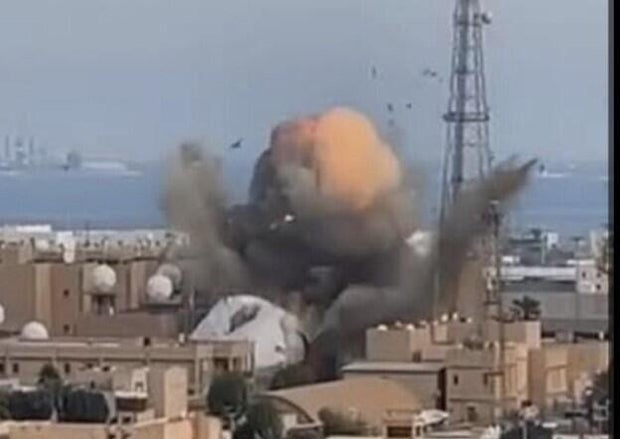
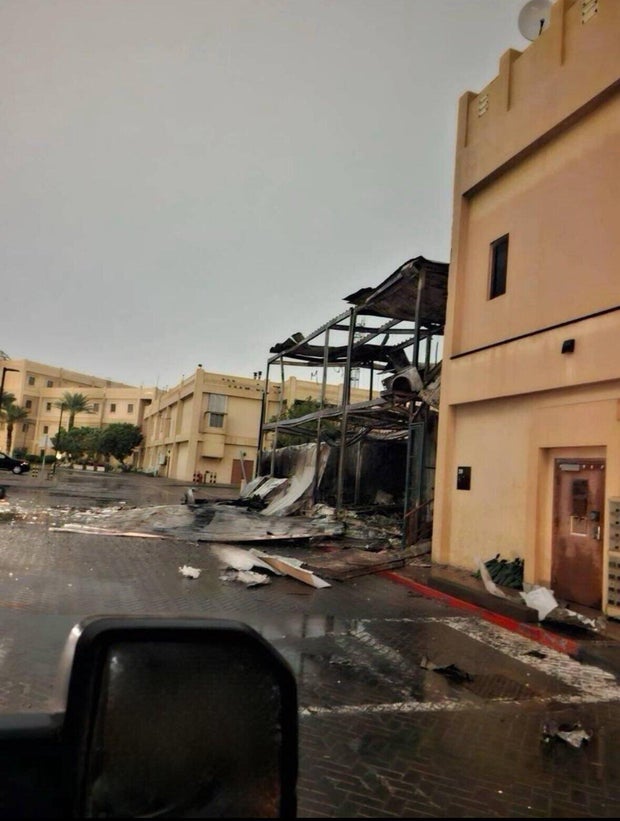
Pentagon has not released a public estimated cost of damage
The U.S. military has not included the damage to bases in its cost estimates of the war so far because officials say they don’t know what will be rebuilt, but acting Navy Secretary Hung Cao in a recent interview with The Epoch Times said Iran’s retaliatory attacks “blew the hell out of Bahrain.”
Since Naval Support Activity Bahrain officially became the headquarters for the Navy’s Fifth Fleet in the ’90s, it has served as a logistics hub for ships in the Middle East, including during the wars in Iraq and Afghanistan. According to the Navy’s website, the facility serves approximately 8,300 military personnel, Defense Department civilian employees and their families.
The damage has impacted sailors at sea as well. Earlier this year, the USS Abraham Lincoln aircraft carrier faced food shortages as the Navy adjusted resupply routes away from Bahrain. The New York Times reported some supplies had to come through Diego Garcia, an island some 2,200 miles away in the Indian Ocean.
The extended route requires 14- to 18-day logistics cycles to deliver supplies to ships, according to a Pentagon Inspector General report. That’s compared to 5 to 7 days from Bahrain, two former officials said. While there are other logistics hubs in the region, Bahrain was a key option before the war began.
Chief of Naval Operations Admiral Daryl Caudle, the Navy’s top officer, at a town hall last month acknowledged the service has had to restructure how it supplies ships in the Middle East.
“There was some early learning there on getting the logistics process in place that I think now we have in a very good situation,” Caudle said.
During the town hall, Caudle told a sailor who was evacuated from Bahrain that officials are working on retrieving belongings that were left behind because the Navy does not have imminent plans to return to the same level of footprint on the base.
“We’re not getting back in there anytime soon, I just want to be completely honest with that,” he said.
According to a Navy spokesperson, service members in Bahrain can ship their household goods and vehicles in person, and those outside Bahrain can designate a representative to act on their behalf, or coordinate travel back to Bahrain to move household goods and vehicles.
Some military families, service members and civilians in a bind
Since those opening days of the war, the Navy has helped evacuate about 1,450 service members and families from Bahrain. Many are now in a financial bind because they’re paying for at least two households — one in Bahrain and another in the U.S.
“We have burned through our savings,” one of the spouses told CBS News. “We have started having to take money out of our kids’ college funds to pay down all the bills that we’re incurring.”
The Pentagon is providing benefits to reimburse housing costs in both places, but families told CBS News claims can take weeks to months to process.
In a statement, a Navy spokesperson said, “The Navy remains in close communication with all affected service members, affiliated civilians and families through command channels and continues to provide timely information, individual case management, and relocation support.”
The spokesperson said families have until the end of November to transition from a safe haven to an established designated residence to continue receiving housing, relocation and separation entitlements.
Even if some families have not struggled financially through this process, all of them have been uprooted. Many were evacuated to Norfolk, Virginia, which is a Navy hub, or to Tampa, Florida, where U.S. Central Command’s headquarters is located.
Blue Star Families, a non-profit that supports military families, provided supplies to evacuees in Tampa, according to Suzy Malloy, the executive director of the chapter in the Tampa Bay region.
“We gave these kids backpacks with school supplies,” Malloy told CBS News. “We gave families brand new clothing, we gave them air fryers and crockpots so that they could cook in hotel rooms until they could adjust to something more permanent,” like an Airbnb or temporary military housing.
Malloy said the evacuees are still in a bit of limbo but are starting to settle into Tampa.
“My opinion is [U.S. Central Command] and their family readiness program have done a remarkable job keeping the train on the tracks,” Malloy said.
None of the families CBS News spoke to blamed the military for their challenges, but are frustrated with the overall situation — the evacuation and the uncertainty that has come after.
“Nobody expected this to go on so long,” one of the spouses said.
About the Author
