
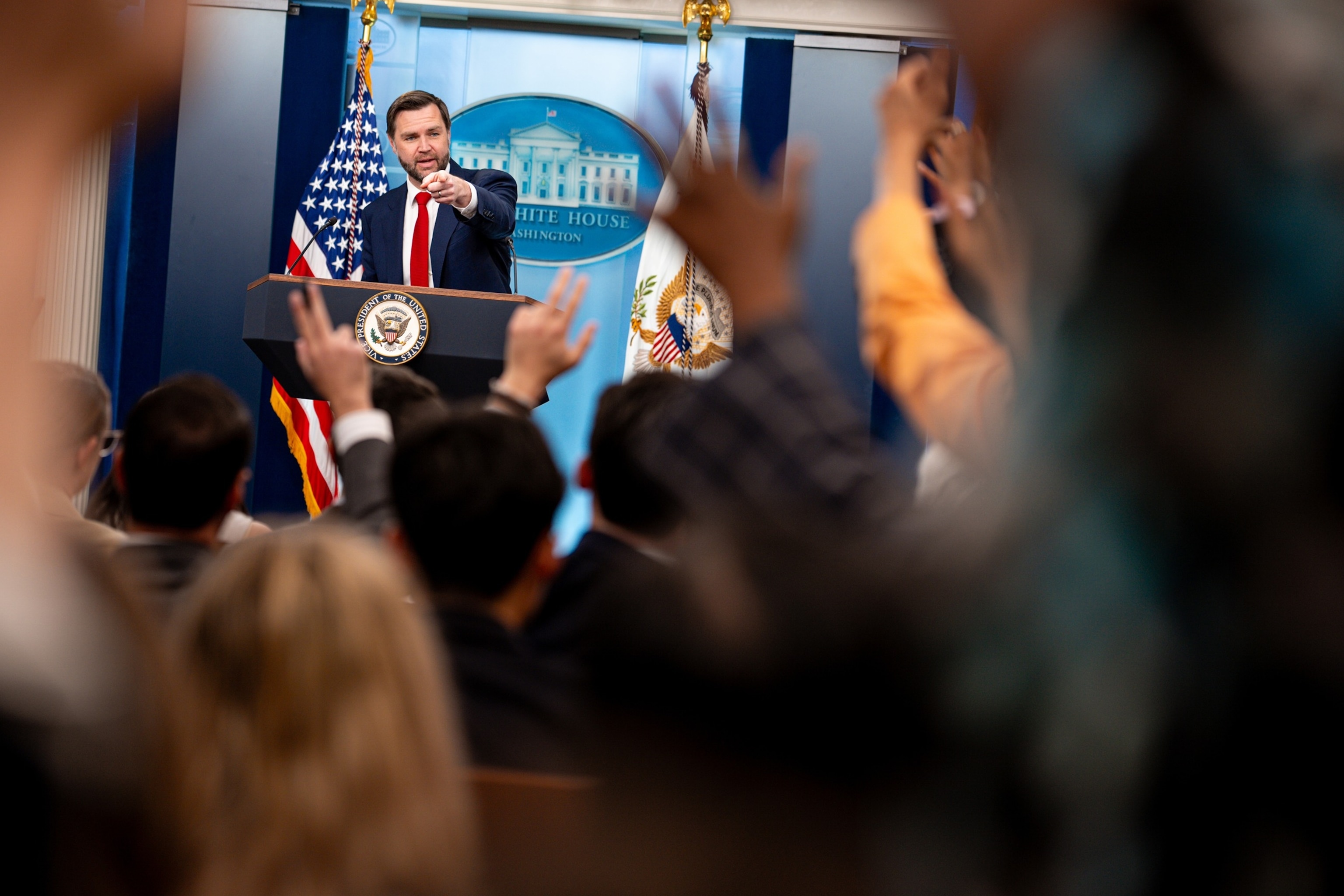
Vice President JD Vance on Thursday directly contradicted what is in the memorandum of understanding between the United States and Iran, touting it as a “win-win” and insisting Iran will only reap financial benefits if they “change their behavior.”
“They don’t get anything unless they change their behavior,” Vance said during a briefing at the White House Thursday morning.
That conflicts with what U.S. officials had said was in the MOU, which states that “immediately upon signing,” the Treasury Department will allow the export of Iranian crude through waivers — a financial windfall for Iran, which has faced sanctions for years. Vance digitally signed the MOU with Speaker Mohammad-Bagher Ghalibaf before President Donald Trump physically signed it Wednesday.
Andrew Harnik/Getty Images
ABC News pushed Vance on the financial rewards that Iran is already receiving simply for reopening the Strait of Hormuz. As part of the agreement, the U.S. is removing its naval blockade of Iranian ports, and Iran will allow commercial traffic through the Strait of Hormuz, which Iran closed after the war started, to be restored to pre-war levels. ABC News asked how Iran is allowed to sell their oil freely without making any new concrete nuclear commitments.
“They’ve made very concrete nuclear commitments. They have committed to the destruction of the highly enriched [uranium] stockpile that they have in their possession,” Vance said, adding that lifting the Strait of Hormuz blockade has promoted “the free flow of energy … across the world.”
However, Vance’s comments conflict with what the deal says. There is no firm commitment from Iran to get rid of their nuclear stockpile — just a commitment to negotiate “the disposition” of it over the next 60 days.
Also, allowing Iran to freely sell oil on the global market now is an economic windfall for Iran, which could generate more than $60 billion a year in revenue, experts told the Wall Street Journal.
Andrew Harnik/Getty Images
Furthermore, Vance defended the oil waivers by arguing the U.S. will gain insight into Iran’s economy.
“So by lifting the blockade, that’s the significant thing that has changed. And by lifting the sanctions, we’re actually going to be able to see a little bit where their financial system actually sends money and receives money. That’s a real benefit to the American people. And that’s really the only thing that has changed by the change in sanctions,” Vance said.
He also repeatedly stressed that U.S. taxpayer money will not flow directly to Iran — “not a single penny, by the way, from the United States of America under any circumstance.” But a final deal could still allow Iran to reap huge financial benefits, including the unfreezing of assets and a $300 billion reconstruction account for Iran — the details of which will be sorted in the 60-day period.
Pressed on whether Iran can be trusted to change its behavior, Vance asked “isn’t it worth trying?”
Democrats — and some Republicans — have expressed concerns about the MOU. Chuck Schumer, the Senate’s top Democrat, said Iran “took Trump to the cleaners” in negotiations over the MOU in remarks on the Senate floor Thursday. Republican Sen. Bill Cassidy said of the MOU on Thursday: “Iran’s left stronger, we’re left weaker.”
“You know, I’ve seen skeptics of the deal. People say ‘the Iranians will never change their behavior.’ Well, maybe that’s true. And if so, they don’t get any of the benefits of the bargain. But isn’t it worth trying? Isn’t it worth seeing whether this incredibly weakened position that the president of the United States has put the Iranians under, whether that motivates them to change their behavior, not just vis a vis the West, but vis a vis the Middle East,” he said.
Iranian Supreme leader Mojtaba Khamenei said Thursday that Iranian officials entered the agreement from a position of strength, portraying the U.S. president as having pushed aggressively for the deal out of desperation.
About the Author
